The Daily 5 is a book (resource) written by Gail Boushey and Joan Moser, also know as "the sisters", which focuses on literacy instruction and independence. It is currently being used in many classrooms across the country.
There are 5 literacy components: Read to Self, Read to Someone, Listen to Reading, Word Work, and Work on Writing.
GETTING STARTED
The most important discovery that I've made after getting started with the Daily 5 was this: Make It Your Own. The Daily 5 is a structure and management piece for a lot of the things you are already doing in your classroom. As with most things, there is more than one way to do the Daily 5. You have to make it work for You and Your classroom.
Digging In
When digging in with the Daily 5, you'll want to focus on your classroom library. My books are arranged in baskets, which I keep on top of counters, and others are displayed on shelves. My classroom library is a combination of books organized by reading level (GRL), genre, theme, topics, and units of study. In fact, how books are arranged is not that important. What's more important is that your students know how to pick "Good Fit Books". One of the first focus lessons that you will teach is the "I Pick" lesson, where you teach students how to pick books that are a good fit for them.
Meeting Area
Another important component of the Daily 5 is creating a meeting area within the classroom. The meeting area is a place where students come together as a group for mini-lessons or focus lessons, book discussions, checking in, and sharing/reflecting on learning. Many teachers anchor the meeting area with a large rug. The rug helps to identify the meeting area for your students.
Signal
Finding a way to get the attention of your students and bringing them back to the meeting area, is the purpose of the signal. There are many creative signals that you can use. I use chimes in my classroom. I love the calm sound of the chimes. For me, it's a calm and quite way to signal my students that we need to stop what we were doing, and go to the meeting area. Music, drums, spoken signals, etc. are other great ways to reconvene your students.
Conferring
One of the best aspects of the Daily 5 is that it builds independence. As the students are working independently on their daily 5 choice, the teacher is able to work with students. This structure allows the teacher time for conferring one-on-one with students, while the rest of the class is busy working on their Daily 5 choice. Choice is key. Having the ability to choose what to work on, engages students and promotes the independent work habits that are so important to a successful Daily 5 round. Take a look at my conferring bag below.
If you would like additional information on the Daily 5, like my conferring bag, refer to my post on Ten Tried and True Tips For Using the Daily 5.
In my next few posts I'll focus on the 5 different components of the Daily 5, so stay tuned and Dig In. You'll be glad you did.
Striving for excellence in teaching, sharing ideas and strategies, and using technology to engage learners at the elementary level. Working in collaboration with other teachers in an effort to continually learn and grow as educators.
Monday, August 22, 2011
Friday, August 12, 2011
WRITE IT DOWN!
As I prepare myself for the beginning of another school year, I have a million thoughts swimming around in my head. It's like filling a teacup with a fire hose. My thoughts range from new ways to arrange my classroom to the best ways to engage above-grade level readers. Many of you are planning to incorporate new structures and strategies from The Daily 5 and the Literacy CAFE. Many of us are anticipating the thrill of blogging with our students for the first time. Other fortunate teachers, I'm extremely jealous of this bunch, are in the process of unpacking new iPads for their students as we speak.
The last days of summer seem to be speeding right by. Okay, some of you have already started the school year, and are probably tired of hearing the rest of us lamenting over summer. Forgive me, but sometimes it's ALL ABOUT ME! Or, that's what I tell myself from time to time. As we prepare for a new school year, and as our classrooms and curriculum maps start to take shape on paper or at least in our minds, what's next on our To-Do lists? WRITE IT DOWN!
Over the summer, I purchased a new journal. This is not to say that I have never kept a journal before, because I have. Whenever I attempt something new or major, that I expect to have a positive impact on my teaching, I keep reflection notes about it. After every new lesson, activity, or instructional piece, I try to reflect on what went well, what didn't go so well, new ideas I want to incorporate next time, and things I want to change. I plan to do those same things this year as well. However, this year my plan is to start on the Very First Day Of School. Additionally, I plan to use my newly purchased journal.
What I like about this journal are the writing prompts. Yes, writing prompts are not just meant to support our students' writing endeavors, but they are helpful to adults who are trying to get their writing juices flowing too. Each day's entry consists of two pages. One page of writing prompts, and a second page for documentation/notes. The writing prompts themselves are great. Here are a few examples: I am concerned about..., People/Students that touched my life..., Goals and ideas for a better tomorrow.... If you want to hear more you'll have to purchase one of these fantastic journals from The Write It Down! series at Journals Unlimited, Inc. The website is http://www.journalsunlimited.com/.
It's never too late to start a journal. Keeping good reflection notes is a part of good teaching, regardless of which tool you use to do it. I'm so excited about using my new journal that I couldn't wait to share it with you. Do you keep a personal or professional journal? I would love to hear your comments about how you use journals (for yourself/teaching) because today, it's ALL ABOUT YOU. So, write it down!
Thursday, August 4, 2011
FAMILY READ-ALONG
I'm always interested in ways to involve parents in learning activities. I don't have to tell you how important it is to promote the home-school connection. A few years ago I came across a wonderful idea for involving parents in the first few weeks, while they're still eager and excited about making the school year a positive experience for their children. I can't recall where I initially came across this idea, but it's one of the best activities that I know of for involving parents. What is it? It's called a Read-along.
The Read-along is an event that involves students, staff, and parents or other family members. It takes place on the 2nd Friday of school, near the end of the school day. The major focus, which I think is the best part, is literacy. The Read-along sets the tone for the school year by letting parents know up front that our classroom is a reading classroom where books are read, shared, and valued. The Read-along is inspired by the book, The Relatives Came by Cynthia Rylant. The story is about a family whose relatives come to visit, and the house is filled with aunts, uncles, and cousins. The relatives spend a few days together eating, talking, sharing, and hugging.
http://amzn.com/B002VK9INW
I start preparing for the Read-along by reading and discussing the book during the first week of school. After the initial reading, I only reread portions of the book. I send home the parent letter on the first Friday of school, along with the other important mail the students take home that week. The Read-along is a surprise event and the kids don't know anything about it. In the letter I tell parents that it's a surprise and not to let the children know about it or it will spoil the surprise. I've held a Read-along with both my third and first grade students. I don't think age really matters, however, as they get older, it becomes more difficult trying to keep it a secret. I'm happy to say that keeping the surprise has never been an issue.
In the letter I tell the parents to bring a handful of books, a blanket, and a few snacks. The Read-along is held during the last hour of the school day on the second Friday of school. I ask parents to report to the classroom at the scheduled time but to wait quietly in the hallway. I prearrange for one parent to knock on the door. A few minutes before the arranged time, I bring the students to the meeting area to discuss a portion of the book again. All of a sudden there is a knock at the door. I ask one of the students to open the door, and to their SURPRISE, their relatives start pouring in. You should see the look on their faces when they realize it's their parents, siblings, aunts, uncles, and grandparents-Their Relatives. The look on their faces is priceless. I take the students and their families to the cafeteria, we spread out, and we read and eat for about half an hour. At the end of the Read-along, we gather everything up and the students leave for home with their parents since this occurs at the end of the school day.
What about the kids whose family can't attend?
I'm always concerned about making sure these kids don't feel left out. First, I determine which families plan to attend and those that will be unable to participate. I do this by asking parents to return an RSVP indicating their intentions, and letting me know if they will attend the Read-along or if another family member (like a grandparent) is planning to attend in their place. Next, I enlist the help of staff members by asking them to adopt students whose parents can't attend the Read-along. The staff people that I enlist are the principal, learning consultant, resource room teachers, parents, and any other available staff that would be willing to adopt students. Finally, I pack extra snacks for those children and they each get their own bag of goodies. Sometimes I group 2 or 3 kids together depending on the number of staff willing to adopt kids. My students truly enjoy this event! Be sure to have your camera handy because there are lots and lots of photo ops during this event.
Monday, July 25, 2011
THE INTERACTIVE READ-ALOUD
Reading aloud to students is one of the most important aspects of literacy in the classroom. For teachers like myself, it's also one of the most enjoyable moments. Even older children enjoy the stories that are read to them by their teachers. What this usually looks like in the lower elementary classrooms is, a classroom of students, sitting on the carpet, gazing up at the teacher who is reading from a rocking chair, and hanging on to her every word. (Let's be honest, others are playing around and distracted.) In upper elementary classrooms the students may be sitting at desks, doodling on a pieces of paper, and attentively listening, as the teacher reads from a special place in the classroom. What about those kids who are not tuned into the story....or distracted and daydreaming? I'm so glad you asked. The Interactive Read-Aloud invigorates the traditional read-alouds taking place in many classrooms. Additionally, it stimulates the learning environment by engaging students in the read-aloud activity.
What makes the reading interactive? Instead of being passive listeners during the Read-Aloud, the students are active participants in the learning and discovery. In addition to listening to the story, the students are discussing elements, recording their thoughts in a Read-Aloud Notebook, and sharing their ideas with classmates. Here's how to get started. All you need is the Read-Aloud book, spiral notebooks for each student, composition books work well too, and a the Ways to Respond In Your Notebook chart, which is described below. Next, make a Book Preview packet. Copy of the book jacket, including the summary/gist of the story, copy the first page of the story, and the author's biography. If the book has a chapter page, copy that as well, or create a document listing the chapters from the book. This is especially important if the chapter titles have names, rather than just numbers. Make a preview packet for each student which includes the previous pages mentioned, and you're ready to get started.
Begin by introducing the Read-Aloud book to your students. Issue each student a book preview packet, and a notebook. Preview the book with the sudents using the preview packet. Next, create a list of questions, about the book, suggested by the students. Record each question on your interactive whiteboard, or on chart paper and save the chart or document. Every day before beginning the reading, review the questions to see if any have been answered. Additionally, record new questions that students have. You can decide how often to add more questions based on your students' input. Some days they may have lots of questions to add, and other days only a few.
READ-ALOUD
Next, start reading the book. I like to read one or two chapters a day, depending on our schedule and the length of the chapters. Allow more time on the day the book is introduced, since the preview and questions will take up a big chunk of your time. You can also preview the book the day before strating the first chapter. As you are reading aloud the book to your students, they are recording their thinking in their notebooks. To support them with this, your students can refer to the Ways To Respond in Your Notebook chart. The chart will give them ideas for how to respond in their notebooks. I created a chart on poster board and hung it in my classroom as an anchor chart. You could also create a chart on you interactive whiteboard and save it for use during each read-aloud session. Here is a list of some of the items I included on my chart:
Ways To Respond In Your Notebook
ASSESSMENTS
What about assessments? The assements are built into the learning activities during the Interactive Read-Aloud. The students' Read-Aloud Notebooks and participation in the discussions, can both be used to assess students' understanding of the story. I like to collect notebooks once a week for this purpose. Additionally, when the story is finished, I have my students construct a written reflection as an additional assessment. Students select one of their best notebook entries to compelete a written reflection of their understanding of the story. I copy the notebook page and staple it to their reflection. Later, when I'm reading their reflections, I can compare them to the entry in their notebook. I also remind students, throughout the book reading, to write good notebook entries. They will be referring to their notebook entries, when writing their reflection piece, once the Read-aloud book is finished.
Below is a list of some of the titles I've used for my Interactive Read-Alouds. As you revive your Read-Aloud time, you will be amazed at how much more your students learn and discover about the stories, as they become active participants in this interactive process.
SUGGESTED BOOKS:
What makes the reading interactive? Instead of being passive listeners during the Read-Aloud, the students are active participants in the learning and discovery. In addition to listening to the story, the students are discussing elements, recording their thoughts in a Read-Aloud Notebook, and sharing their ideas with classmates. Here's how to get started. All you need is the Read-Aloud book, spiral notebooks for each student, composition books work well too, and a the Ways to Respond In Your Notebook chart, which is described below. Next, make a Book Preview packet. Copy of the book jacket, including the summary/gist of the story, copy the first page of the story, and the author's biography. If the book has a chapter page, copy that as well, or create a document listing the chapters from the book. This is especially important if the chapter titles have names, rather than just numbers. Make a preview packet for each student which includes the previous pages mentioned, and you're ready to get started.
Begin by introducing the Read-Aloud book to your students. Issue each student a book preview packet, and a notebook. Preview the book with the sudents using the preview packet. Next, create a list of questions, about the book, suggested by the students. Record each question on your interactive whiteboard, or on chart paper and save the chart or document. Every day before beginning the reading, review the questions to see if any have been answered. Additionally, record new questions that students have. You can decide how often to add more questions based on your students' input. Some days they may have lots of questions to add, and other days only a few.
READ-ALOUD
Next, start reading the book. I like to read one or two chapters a day, depending on our schedule and the length of the chapters. Allow more time on the day the book is introduced, since the preview and questions will take up a big chunk of your time. You can also preview the book the day before strating the first chapter. As you are reading aloud the book to your students, they are recording their thinking in their notebooks. To support them with this, your students can refer to the Ways To Respond in Your Notebook chart. The chart will give them ideas for how to respond in their notebooks. I created a chart on poster board and hung it in my classroom as an anchor chart. You could also create a chart on you interactive whiteboard and save it for use during each read-aloud session. Here is a list of some of the items I included on my chart:
Ways To Respond In Your Notebook
- Make a prediction
- Ask a question
- Draw a picture of your favorite part-include a caption or summary
- Summarize the chapter(s)
- Describe a character
- Record a quote from the story and explain what you think it means
- Describe a part you liked/ tell why
- Describe a part you didn't like/tell why
- Describe something you didn't understand
- Make a list of interesting words
- Explore the title-explain why you think the writer chose this title
ASSESSMENTS
What about assessments? The assements are built into the learning activities during the Interactive Read-Aloud. The students' Read-Aloud Notebooks and participation in the discussions, can both be used to assess students' understanding of the story. I like to collect notebooks once a week for this purpose. Additionally, when the story is finished, I have my students construct a written reflection as an additional assessment. Students select one of their best notebook entries to compelete a written reflection of their understanding of the story. I copy the notebook page and staple it to their reflection. Later, when I'm reading their reflections, I can compare them to the entry in their notebook. I also remind students, throughout the book reading, to write good notebook entries. They will be referring to their notebook entries, when writing their reflection piece, once the Read-aloud book is finished.
Below is a list of some of the titles I've used for my Interactive Read-Alouds. As you revive your Read-Aloud time, you will be amazed at how much more your students learn and discover about the stories, as they become active participants in this interactive process.
SUGGESTED BOOKS:
- The Tale of Despereaux by Kate Dicamillo
- The Miraculous Journey of Edward Tulane by Kate Dicamillo
- The Beloved Dearly by Doug Cooney
- Journey by Patricia Maclachlan
- Shredderman by Wendelin VanDraanen
- The Toothpaste Millionaire by Jean Merrill
- Fourth Grade Rats by Jerry Spinelli
- Maniac Magee by Jerry Spinelli
- Lawn Boy by Gary Paulsen
Saturday, July 23, 2011
WRITING WITH TOOLS NOT TEARS
Some students love to write, some tolerate it, and others just hate it. You know the scenario....the student sits and stares at a blank piece of paper for what seems like forever. How do we get our most relunctant writers writing? Even better, how do we get them excited about writing. Every teacher has at one time or another had one or two students who didn't enjoy writing. Okay, I'll say it, some students hate writing. However, it really isn't that they hate it, they just don't feel they're good at it. It makes perfect sense. I mean, what person would enjoy something that they're not very good at. Think about it. Bad cooks don't enjoy cooking. Nobody enjoys eating their cooking. Terrible singers don't enjoy singing. Wait a minute. I'm a bad singer, and I LOVE singing. It's my family that doesn't like hearing it. Well, that was a bad example, but you get the point. If students were better writers they would enjoy writing. Furthermore, in order for students to become better writers, they need to write more often. It's a vicious cycle.
Until last year I taught third grade. By the time kids reach third grade, teachers usually have two or three relunctant writers in their classrooms. Currently, I'm teaching first grade. First grade writers are a totally different entity. Most students are emergent readers and writers entering first grade. Therefore, they're just learning how to read and write. I don't know about you, but I certainly don't want to be the one responsible for their displeasure for writing. How can we get primary students off to a good start with writing? What tools, strategies and best practices, can we utilize to engage students in the writing opportunities that exist in the classroom? How can use technology to support them in their writing? Here is another way:
I came across a website called ReadWriteThink. They have something called a Comic Generator. Students can create their own comics on the computer or interactive whiteboard. The Comic Generator allows students to choose from different layouts, characters, and settings. The best part of all, the student has to WRITE the captions and dialogue. After the comic is completed it can be printed or edited. If you have an interactive whiteboard, your students could present their comics to their classmates. I created a comic of my own as an example. Take a look and see if you can get the gist of my comic.
Did you get it? I'm dreaming about the first day of school and hoping I remember everything. I'm upset because I have to go to school, even though I look and feel terrible. Finally, I discover that it's Saturday. Okay, so it's not very good, but I bet my first graders will do a lot better. More importantly, they'll have so much fun creating, that they'll forget they're WRITING!
The website for the Comic Generater is http://www.readwritethink.com/
Thursday, July 21, 2011
TEN TRIED AND TRUE TIPS FOR THE DAILY 5
1. Laminate Anchor Charts~Create anchor charts with the students. Record their ideas. Afterwards, neatly rewrite charts and fancy them up as desired. Laminate the final chart and hang in the classroom. Next year, create anchor charts with your new students, but instead of rewriting the chart for display puposes, pull out the laminated chart from the previous year (it will have similar information) and hang it.

2. Check for Understanding Strategy~The Sisters suggest using checkmarks cut from wood, with the strategy written on them. Instead, use precut rectangular pieces of foam. Use a permanent marker to record "Check for Understanding" on one side and "Who?" and "What?" on the reverse side. These foam pieces can be purchased from craft stores. They are extremely durable and inexpensive.
3. Listen to Reading~Use classroom computers as a Listen to Reading station. There are many great websites where students can listen to stories on-line. Some of my favorites are http://www.starfall.com/ and http://www.storylineonline.net/.
4. Creat a Reading Bag~A bag or tote with pockets works best. The tote would include the following items:
5. Repertoire of Mentor Texts~Locate a number of menor texts in advance. Use these during your minilessons or focus lessons. Short texts are best because you can finsih the entire text within the time frame of your focus lesson and the students are able to focus on the strategy being taught.
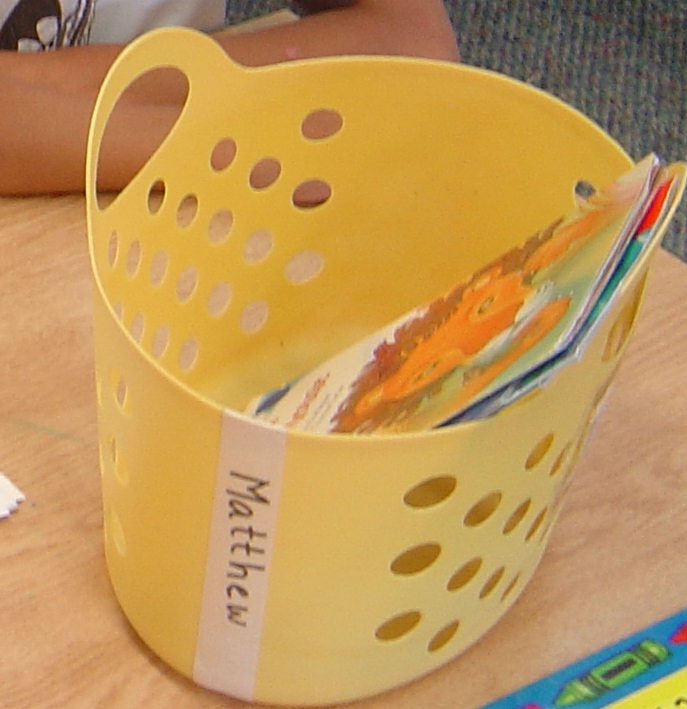
6. Book Baskets~Be creative when looking for appropriate book boxes or book baskets. Many teachers use book boxes which can be a little costly. A good substitue is a book basket. Baskets can be purchased at the Dollar Store and they come in a variety of colors.
7. Strategy Board~Instead of writing the student's name on a sticky note and placing the note next to the strategy the student is working on, use a photo of the student instead. At the beginning of the school year take head shots of each child. Place the child's picture on the strategy board next to the strategy he/she is working on.
8. Keep Track of Read-Alouds~Keep a record of all books that are read aloud to your students. Keep this list posted somewhere in the classroom. Update the list daily/weekly (this could be a classroom job.) Record the book title, author, and genre. Poster board works well, but I prefer a scroll. Make one by stapling papers together and rolling up and unrolling as you add books to your list. At the end of the school year you can revisit some of the favorites from the list.

2. Check for Understanding Strategy~The Sisters suggest using checkmarks cut from wood, with the strategy written on them. Instead, use precut rectangular pieces of foam. Use a permanent marker to record "Check for Understanding" on one side and "Who?" and "What?" on the reverse side. These foam pieces can be purchased from craft stores. They are extremely durable and inexpensive.
3. Listen to Reading~Use classroom computers as a Listen to Reading station. There are many great websites where students can listen to stories on-line. Some of my favorites are http://www.starfall.com/ and http://www.storylineonline.net/.
4. Creat a Reading Bag~A bag or tote with pockets works best. The tote would include the following items:
- Dry Erase Board
- Dry Erase Markers
- Pensieve
- Leveled Books
- Sticky Notes
- Pencils
- Word Cards/Letter Cards
5. Repertoire of Mentor Texts~Locate a number of menor texts in advance. Use these during your minilessons or focus lessons. Short texts are best because you can finsih the entire text within the time frame of your focus lesson and the students are able to focus on the strategy being taught.
6. Book Baskets~Be creative when looking for appropriate book boxes or book baskets. Many teachers use book boxes which can be a little costly. A good substitue is a book basket. Baskets can be purchased at the Dollar Store and they come in a variety of colors.
7. Strategy Board~Instead of writing the student's name on a sticky note and placing the note next to the strategy the student is working on, use a photo of the student instead. At the beginning of the school year take head shots of each child. Place the child's picture on the strategy board next to the strategy he/she is working on.
8. Keep Track of Read-Alouds~Keep a record of all books that are read aloud to your students. Keep this list posted somewhere in the classroom. Update the list daily/weekly (this could be a classroom job.) Record the book title, author, and genre. Poster board works well, but I prefer a scroll. Make one by stapling papers together and rolling up and unrolling as you add books to your list. At the end of the school year you can revisit some of the favorites from the list.
9. Utilize Technology~If you have a Smart Board, you can use some of the smart tools to create an electronic version of the Daily 5 check-in. Students move their icons/pictures/symbols to indicate their Daily 5 choice.
10. Be Resourceful~There are a lot of great resources available that will complement what you're doing with the Daily 5. Two of my favorite teacher resources are Growing Readers-Units of Study in the Primary Classroom by Kathy Collins, and Words Their Way-Word Study for Phonics, Vocabulary, and Spelling Instruction (Pearson-Merrrill/Prentice Hall). Read what others have to say on the subject and make it your own.
Subscribe to:
Posts (Atom)