Showing posts with label classroom management. Show all posts

Monday, August 22, 2011

DIGGING IN WITH THE DAILY 5

The Daily 5 is a book (resource) written by Gail Boushey and Joan Moser, also know as "the sisters", which focuses on literacy instruction and independence.   It is currently being used in many classrooms across the country.
There are 5 literacy components:  Read to Self, Read to Someone, Listen to Reading, Word Work, and Work on Writing.

GETTING STARTED
The most important discovery that I've made after getting started with the Daily 5 was this: Make It Your Own. The Daily 5 is a structure and management piece for a lot of the things you are already doing in your classroom.  As with most things, there is more than one way to do the Daily 5. You have to make it work for You and Your classroom. 

Digging In
When digging in with the Daily 5, you'll want to focus on your classroom library.  My books are arranged in baskets, which I keep on top of counters, and others are displayed on shelves.  My classroom library is a combination of books organized by reading level (GRL), genre, theme, topics, and units of study.  In fact, how books are arranged is not that important.  What's more important is that your students know how to pick "Good Fit Books".  One of the first focus lessons that you will teach is the "I Pick" lesson, where you teach students how to pick books that are a good fit for them.

Meeting Area
Another important component of the Daily 5 is creating a meeting area within the classroom.  The meeting area is a place where students come together as a group for mini-lessons or focus lessons, book discussions, checking in, and sharing/reflecting on learning.  Many teachers anchor the meeting area with a large rug.  The rug helps to identify the meeting area for your students.

Signal
Finding a way to get the attention of your students and bringing them back to the meeting area, is the purpose of the signal.  There are many creative signals that you can use.  I use chimes in my classroom.  I love the calm sound of the chimes.  For me, it's a calm and quite way to signal my students that we need to stop what we were doing, and go to the meeting area.  Music, drums, spoken signals, etc. are other great ways to reconvene your students.

Conferring
One of the best aspects of the Daily 5 is that it builds independence.  As the students are working independently on their daily 5 choice, the teacher is able to work with students.  This structure allows the teacher time for conferring one-on-one with students, while the rest of the class is busy working on their Daily 5 choice.  Choice is key.  Having the ability to choose what to work on, engages students and promotes the independent work habits that are so important to a successful Daily 5 round. Take a look at my conferring bag below.


If you would like additional information on the Daily 5, like my conferring bag, refer to my post on Ten Tried and True Tips For Using the Daily 5.

In my next few posts I'll focus on the 5 different components of the Daily 5, so stay tuned and Dig In.  You'll be glad you did. 

Thursday, July 21, 2011

TEN TRIED AND TRUE TIPS FOR THE DAILY 5

1.  Laminate Anchor Charts~Create anchor charts with the students.  Record their ideas.  Afterwards, neatly rewrite charts and fancy them up as desired.  Laminate the final chart and hang in the classroom.  Next year, create anchor charts with your new students, but instead of rewriting the chart for display puposes, pull out the laminated chart from the previous year (it will have similar information) and hang it.


2.  Check for Understanding Strategy~The Sisters suggest using checkmarks cut from wood, with the strategy written on them.  Instead, use precut rectangular pieces of foam.  Use a permanent marker to record "Check for Understanding" on one side and "Who?" and "What?" on the reverse side.  These foam pieces can be purchased from craft stores.  They are extremely durable and inexpensive.


3.  Listen to Reading~Use classroom computers as a Listen to Reading station.  There are many great websites where students can listen to stories on-line.  Some of my favorites are http://www.starfall.com/ and http://www.storylineonline.net/.

4.  Creat a Reading Bag~A bag or tote with pockets works best.  The tote would include the following items: 
  • Dry Erase Board
  • Dry Erase Markers
  • Pensieve
  • Leveled Books
  • Sticky Notes
  • Pencils
  • Word Cards/Letter Cards


5.  Repertoire of Mentor Texts~Locate a number of menor texts in advance.  Use these during your minilessons or focus lessons.  Short texts are best because you can finsih the entire text within the time frame of your focus lesson and the students are able to focus on the strategy being taught.

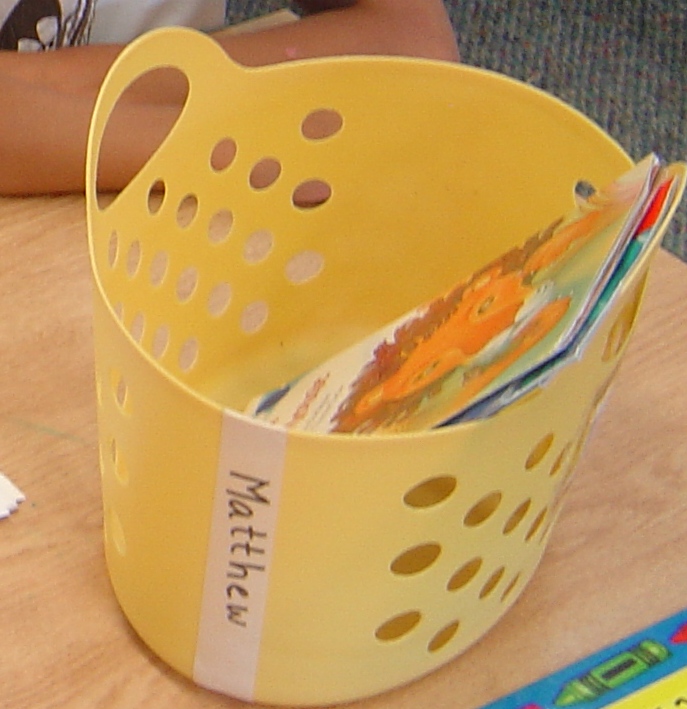
6.  Book Baskets~Be creative when looking for appropriate book boxes or book baskets.  Many teachers use book boxes which can be a little costly.  A good substitue is a book basket.  Baskets can be purchased at the Dollar Store and they come in a variety of colors.


7.  Strategy Board~Instead of writing the student's name on a sticky note and placing the note next to the strategy the student is working on, use a photo of the student instead.  At the beginning of the school year take head shots of each child.  Place the child's picture on the strategy board next to the strategy he/she is working on.


8.  Keep Track of Read-Alouds~Keep a record of all books that are read aloud to your students.  Keep this list posted somewhere in the classroom.  Update the list daily/weekly (this could be a classroom job.)  Record the book title, author, and genre.  Poster board works well, but I prefer a scroll.  Make one by stapling papers together and rolling up and unrolling as you add books to your list.  At the end of the school year you can revisit some of the favorites from the list.

9.  Utilize Technology~If you have a Smart Board, you can use some of the smart tools to create an electronic version of the Daily 5 check-in.  Students move their icons/pictures/symbols to indicate their Daily 5 choice.

10.  Be Resourceful~There are a lot of great resources available that will complement what you're doing with the Daily 5.  Two of my favorite teacher resources are Growing Readers-Units of Study in the Primary Classroom by Kathy Collins, and Words Their Way-Word Study for Phonics, Vocabulary, and Spelling Instruction (Pearson-Merrrill/Prentice Hall).  Read what others have to say on the subject and make it your own.