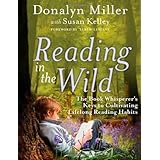

Beginning this week and for the month of July, I'm participating in #CyberPD (online professional development). A group of educators, like me, will be reading the book, Reading in the Wild: The Book Whisperer's Keys to Cultivating Lifelong Reading Habits by Donalyn Miller. We'll be writing reflections about the book on our blogs, commenting on the blogs of others who are participating, and using Twitter to continue the conversations. In this first session, I'll be reflecting on Chapters 1 and 2. This event is hosted by Cathy Mere, Laura Komos, and Michelle Nero. Thank you, ladies, for hosting this wonderful event.
I've been thinking about what it means to be a "wild" reader a lot lately. As a first grade teacher, I'm working with students who are at the beginning of their reading journeys. I want them to see themselves as readers. While reading this book, I was looking through the lens of a first grade teacher and asking myself how these ideas might impact my own teaching.
Chapter 1
Wild Readers Dedicate Time to Read
Some Important Considerations:
- "Students need to connect with other readers and participate in a reading culture that values them. Our students must see themselves as readers, or they will never embrace reading beyond school." (p. 9)
- "It is difficult for many children to become wild readers if they don't read during the edge times." (wasted moments in between our daily commitments) (p. 13)
- "Reading a book in one sitting (binge reading) is a rare indulgence, but most wild readers take advantage of the random Saturday or vacation and read books cover to cover." (p. 16)
- "Most wild readers prefer a relaxing, quiet environment." (p. 23)
- "Fake reading and reading avoidance commonly occur when students lack independent reading habits, confidence, or adequate reading skills." (p.25)
- "As teachers, we need to reclaim reflective practices for ourselves and use it as a tool to continually recalibrate our teaching to our core beliefs, determine what is and isn't working, and focus our teaching so we can continue to offer quality instruction that we can reasonably manage and maintain throughout the school year." (p.41)
- My first graders participate in partner reading time, daily. They enjoy sharing and discussing books with peers and value this opportunity.
- I'm always looking for creative ways to encourage my first graders to read outside of the classroom. Last year, we carried books to read in between our gym and music specials. We used this "edge time" to read more books.
- As an adult reader, I enjoy binge reading. I know that I'm hooked when I continue to think about the characters long after I have finished reading the book. As a first grader teacher, I might have 1 or 2 binge readers in my classroom each year. These students tend to read above grade level and have positive reading experiences outside of school. I can model this behavior for all of my first graders by discussing and reminding them of the characters we know and love from books we've shared as class.
- All students appreciate a quiet classroom during reading time. Reading is thinking. Our reading environment must support the reading and thinking we do all year.
- I refer to fake-reading as "pretend reading" in my classroom. I had a student who struggled in this area for most of the school year. His reading was above grade level. However, he did not value our reading time and complained of being bored. It took me months to discover that he was not selecting books he was interested in reading. Donalyn's warning signs (p. 27) are a helpful reminder of what students do when they are not really reading. She also shares how to address these behaviors in chapter 1.
- Reflection is the key to almost everything we do as teachers. Like many educators, I'm constantly reflecting on my teaching. Each year I find myself tweaking my teaching practices and classroom routines in an effort to support learners and provide a positive classroom experience for my students.
Wild Readers Self-Select Reading Material
Some Important Considerations:
- "When students select their own books to read and enjoy, they develop confidence in their abilities to make reading choices and build their capacity for choosing books in the future." (p. 46)
- "Read-alouds provide students with support in choosing their own books by increasing their title and author awareness, improving their background knowledge and experience, and fostering increased motivation and engagement with reading through positive reading experiences." (p. 56)
- "Book drawings are an engaging and fun way to introduce new books to students and encourage risk taking. Students are more willing to try unfamiliar books when I endorse them and classmates express enthusiasm for reading them. Even students who don't enter drawings build title and author awareness." (p.58)
- "The more we know about books and our individual students, the better support we can provide." (p. 64)
- "Students who regularly choose books that they can't read or don't enjoy are unlikely to read much or find reading personally gratifying. Exposing students to lots of books and positive reading experiences while building a network of other readers who support each other provides student with tools that last beyond the classroom setting." (p. 70)
- "Providing students with scaffolded opportunities to preview, evaluate, and choose texts gives them the practice they need in self-selecting books." (p.71)
- Managing a classroom library requires curation--selecting the best, most current materials for curriculum needs and students' interests." (p. 80)
- My first graders enjoy choosing their own books to read. Allowing them to fill their baskets with books of their choice is a huge motivator for reading.
- Our Read-Aloud time is one of our favorites parts of the school day. I love the idea of allowing students to select the next read-aloud using book commercials. (p. 54)
- We use the "Random Name Generator" on our Interactive White Board to randomly select students who want dibs our the newest additions to our classroom library or the next book in a series that was recently introduced. It's is fast and effective with my first graders because they know the computer is doing the choosing rather than the teacher.
- Getting to know our readers is vital. I've tried a number of different ways over the years, such as reading surveys and the like. Last year, when I had a student teacher, I was able to conduct reading interviews with my first graders which provided some helpful information. It's amazing how well you get to know the readers in your classroom when you talk to students even during informal gatherings like "lunch bunch" celebrations. It's a matter of noticing, listening, and noting.
- Making sure that my first graders have books they can read and enjoy is always a challenge. On any given day I encounter children who are sitting with baskets of books that are too challenging for them to read. This tends to be especially true of my struggling readers who desire to have a successful reading experience as they build stamina and encounter books they enjoy and connect with. I'm wondering what would be the best way to approach a first grade friendly "Reading Selection Reflection". Perhaps this could be accomplished in small groups by creating an anchor chart based on their input. I'll have to consider this idea further.
- Occasionally, I create tubs of books for students who need this extra support. The books are at their reading levels and they do their book shopping out of these prearranged tubs. They still have choice, however, they are not yet ready to choose books from our entire classroom library. I have found this support to be quite successful. Also, I love Donalyn's suggestion to "Unpack your thinking when evaluating a book and share it with students." (p. 71) This would make a great mini-lesson and one that I need to share with my first graders periodically throughout the school year.
- Our classroom library is one of those areas that is a work in progress. I'm constantly working on the best way to arrange books and make them accessible to my first graders. I also have a bit of a book addiction and I'm always buying new titles to add to our collection. I love the idea of allowing students to carefully rummage through the books even before you introduce them to how to use the library. One of my favorite first grade moments was the day I opened two boxes of donated books in front of my first graders and shared the books inside. It was like Christmas in September. That was a blast!


