
My 10 For 10 Picture Book Favorites
 The Old Woman Who Named Things
 Written by Cynthia Rylant and illustrated by Kathryn Brown
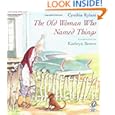
Cynthia Rylant is one of my favorite picture book authors. We read a lot of her books in my first grade classroom. She has two books on this list, so that in itself speaks volumes for her work. The Old Woman Who Named Things is about an old woman who names the things around her. She names her car, her furniture, her house, etc. She names the things she knows she will never outlive. This is all good and fine until she meets a puppy that she becomes very attached to. After much reluctance on the old woman's part, she finally names the puppy.
The Old Woman Who Named Things is a wonderful story to read when building conversations around the themes of love, loss, and loneliness. We use it to help us create a classroom community that is sensitive to those ideas. I have also used this text with my first graders to demonstrate the comprehension strategy, checking for understanding. It's a favorite in my classroom each year. Look closely at the cover illustration...don't you just love her cowboy boots? I think they're hilarious. They really give you a glimpse of the old woman's character.
Sometimes I'm Bombaloo
By Rachel Vail and illustrated by Yumi Heo
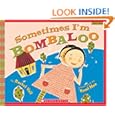
Sometimes I'm Bombaloo is one of the books I read during the first days of school. I use it to introduce one of our classroom structures, The Safe Place. The Safe Place is an area in my classroom where students can go when they feel sad, angry, or just plain "bombaloo". It's just a bean bag which I've placed next to our Friends and Family board. Sometimes I'm Bombaloo is about a girl who gets angry at different times throughout her day and finds that it can be a little scary having to deal with those feelings. It's a great book that helps students recognize and deal with their own anger. My students make lots of connections to the story and it helps us build important conversations around feelings, how we handle disagreements, and what we can do when we need a few minutes to ourselves.
Chrysanthemum
By Kevin Henkes
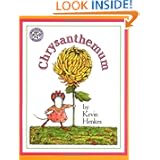
Chrysanthemum is book written by one of our favorite authors, Kevin Henkes. It's another go-to book I read when we are talking about feelings, and building a classroom community where everyone feels valued. In the story Chrysanthemum is teased because her name is too long, and she's named after a flower. The teasing finally stops when the music teacher tells everyone that she has a long name, and that her name is a flower too. Chrysanthemum is also one of our favorite books to use when we are focusing on expanding our vocabulary and tuning into interesting words.
No, David!
By David Shannon
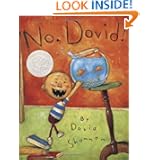
No, David! is a big hit in my classroom each year. I'm always prepared for lots of laughter when I get to the page where David is running down the street naked. My students think it's hysterical. It's one of the best picture books that I've come across for helping students make inferences. I love that it's a quick read since my first graders don't have a lot of stamina, in the beginning of the school year. We read all of the David
books in my classroom.
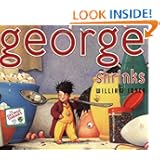
George Shrinks
By William Joyce
The first time I read George Shrinks, I fell in love with it. It's a story about a boy who dreams that he turns small. The suspense starts on the very first page, when the letters GO FROM LARGE to small type. I love the colorful illustrations in this book. Imagine being smaller than all of your toys, sitting on a spoon, and riding on your baby brother's back. Joyce creates a story that uncovers the childhood imagination at its best. You can't beat that for excitement!
The Paper Bag Princess
By Robert Munsch and illustrated by Michael Martchenko

If I had to sum up this book in one word, it would be "Empowering". The Paper Bag Princess is sure to empower young girls everywhere. It's not your typical princess story. There's a prince, a princess, and a dragon to boot. However, Munsch gives this story so much more. The Paper Bag Princess doesn't wear a beautiful gown, instead she wears a paper bag, she outsmarts the dragon, and she calls the prince a "bum". This princess has courage, smarts, and lots of attitude.
The Relatives Came
By Cynthia Rylant and illustrated by Stephen Gammell
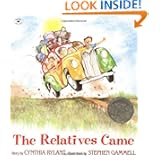
This is the second book by Cynthia Rylant that made my Top 10 list. The Relatives Came is the story of a family that packs up all their things, jumps in their car, and drives all day to visit relatives. When they get to their destination there's lots of hugging, pulling, crying, eating, and snoring as the relatives sleep all over the house, in the beds and on the floors. Most students can relate to the happy times that the relative have during their visit. I use this book to prepare them for our Family Read-Along. Parents are invited to bring in books, blankets, and snacks on the second Friday of the new school year. My first graders are so surprised to see their "relatives" arrive at our door, unannounced. It's our first reading event of the school year and it's a great way to show parents how much we value reading.
The Table Where Rich People Sit
By Byrd Baylor and illustrated by Peter Parnall
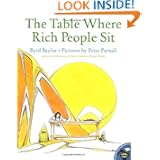
The Table Where Rich People Sit was given to me some years ago by one of my students. It's been one of my favorites ever since. I love the messages in this story. The Table Where Rich People Sit is about a girl who thinks her family needs to get more serious about their financial situation. She calls a family meeting to talk to them but instead she gets a lesson on what is truly important in life. The pages have a lot of text. I usually save this on for the second half of the school year when my first graders have more stamina to sit for longer periods of time. It's a great story to build conversations around the things we value in life and how we can be rich in ways that have very little to do with money.
My Teacher Likes To Say
By Denise Brennan-Nelson and illustrated by Jane Donovan
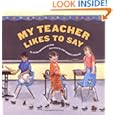
I love language and sharing idioms, proverbs, and cliches with my students. My Teacher Likes to Say is a visual interpretation of those familiar idioms/proverbs/cliches. Children, especially first graders, are not at all accustomed to hearing adults speak in these "funny" kinds of ways. When I was a kid, my teachers often used phrases like, "put on your thinking caps". Needless to say, I enjoy sharing some of these idioms with my students. One of my favorites is, "please button you lip". Read the book...it's a great way to share these fun sayings.
What Do You Do With A Tail Like This?
By Steve Jenkins and Robin Page
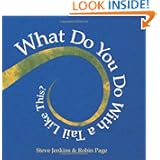
Steve Jenkins is one of my favorite writers of nonfiction. He doesn't disappoint with What Do You Do With A Tail Like This? Jenkins introduces readers to all kinds of animals, and shows us how these animals use the different parts of their bodies. In the very first pages of the book you're shown various noses, and my first graders love guessing which animals they belong to. If you need more nonfiction books in your classroom library, your students will certainly enjoy this wonderful addition.
I hope you find this list helpful. There were so many others I wanted to add to the list. After all, It's 10 for 10!
You can see more August 10 for 10 Picture Book lists at Cathy Mere's site, Reflect and Refine.


